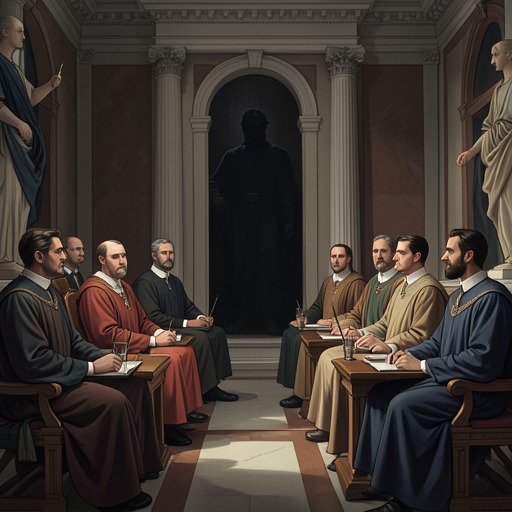
Seneca
Quo VadisSeneca’s role in the novel is defined by a painful divide between moral insight and political submission. A philosopher and former tutor to Nero, he understands the crimes of the court and can name its evasions, but years of accommodation have weakened his capacity to act on what he knows. His conversations with Aulus Plautius, Petronius, and Nero make that compromise visible: Seneca offers counsel and irony, sometimes recognizes what justice would require, yet cannot turn his understanding into dependable protection for the innocent.
Identity and Position at Court
Seneca belongs to the imperial circle through his former instruction of Nero, a connection that gives him access but also leaves him exposed to the ruler’s suspicion. Aulus Plautius visits him while seeking a way to recover Lygia after Nero has claimed her as a hostage under imperial guardianship. Seneca is ill with a fever, but receives the general respectfully. He warns that even visible sympathy could make matters worse: if Nero suspected that Seneca wanted to help, he might refuse to return Lygia simply to spite him.
Seneca’s position is therefore not straightforward authority. He knows the court’s people and its dangerous incentives, but his influence is conditional on concealing his sympathies. He advises Aulus against appealing to Tigellinus, Vatinius, or Vitellius: money might secure their cooperation, or they might welcome a chance to injure Petronius, but they could instead report how much Lygia matters to Aulus and harden Nero’s resolve. Advice in this court is itself risky, because a private plea can be converted into evidence of an attachment to exploit.
Conscience and Compromise
In speaking to Aulus, Seneca turns his criticism inward. He mocks the general for having remained silent through Nero’s crimes and for failing to flatter the ruler with praise after Britannicus’s death and Octavia’s execution. The irony is double-edged: Seneca knows that silence and courtly compliance have become habits of survival, and he describes the political foresight of courtiers as a form of successful moral evasion.
His private conduct sharpens the contrast between his philosophical ideals and his actual life. Seneca drinks water from the fountain at the impluvium and observes that it is safer than wine in his own house, since poisoning the public aqueduct would require poisoning every fountain in Rome. The practical joke carries a grave implication: fear has entered even ordinary domestic life. The narration makes clear that Seneca’s deeper illness is spiritual. Unlike philosophers who can hold to their principles, he has made a series of concessions to crime; he understands that a follower of Zeno should have taken another road, and suffers over that failure more than over the prospect of death.
When Aulus asks him to identify a way to influence Petronius, Seneca admits that the two men belong to opposite camps and that Petronius yields to nobody. He nevertheless proposes a blunt appeal: tell Petronius that his action was ugly and shameful. Seneca judges that Petronius may still respond to shame, even though he no longer distinguishes good from evil in the way Seneca expects. The suggestion is modest, but it shows Seneca trying to use moral language where political leverage has failed.
Counsel, Power, and the Court’s Crises
After the Great Fire, Seneca participates in a consultation at the House of Tiberius, which survived the flames. Petronius proposes leaving Rome for Greece and then travelling to Egypt and Asia Minor, arguing that the journey had already been planned and that the city now offered danger and grief. Nero eagerly accepts the proposal. Seneca, however, warns that departure would be easier than return. His brief objection punctures the fantasy of escape: the crisis is not merely a matter of finding a safer place, but of what Nero’s rule has made politically possible.
Seneca’s caution does not amount to an effective resistance. Later, when Nero’s circle seeks to blame Christians for the fire, Seneca argues that even if they did not burn Rome, they ought to be exterminated for the city’s good. The claim converts the absence of evidence into a reason for political expediency. It stands in sharp contrast with Seneca’s awareness of the court’s falsehoods and with the innocence Petronius recognizes in the accused. Seneca’s moral understanding remains present, but his public reasoning can still serve the machinery of repression.
Petronius tries to challenge that machinery directly. In Nero’s presence, he says the Christians may be punished, but insists that the court should at least admit privately that they did not burn Rome. He condemns the performance of blaming the innocent as a shabby theatrical fiction and warns Nero that future generations will judge the ruler for denying responsibility and casting blame on victims. Seneca’s earlier advice to Aulus had already revealed the cost of such candor: in this court, speaking for the vulnerable can expose both the speaker and the person he wants to protect. Seneca recognizes the danger, but does not take Petronius’s public stand.
Philosophical Identity and Religious Difference
Nero’s hostility toward Stoic philosophers makes the political pressure on Seneca explicit. Nero declares his hatred of Thrasea, Musonius, and Cornutus, associating them with speech he finds repellent, contempt for art, and deliberate simplicity. Seneca is not named as the immediate target in that exchange, but Nero’s dismissal of his philosophical associates places their tradition under suspicion. Chilo answers by joking that Seneca owns a thousand citrus-wood tables and can be surpassed if Nero wishes, presenting Stoicism as something that could be dressed in luxury. The exchange shows how a courtier can turn philosophical identity into an adaptable performance for imperial approval.
Seneca’s own conduct confirms that the problem is more than a clash of labels. He is associated with Stoic principles and understands the standard they set, yet his life has been marked by concessions. The gap between doctrine and conduct is not a simple exposure of hypocrisy: the novel presents it as an inward source of suffering, while also showing how courtly power rewards accommodation and punishes principled distance.
Refusal and Confinement
Seneca’s clearest break with Nero comes when the emperor orders him, together with Acratus and Secundus Carinas, to travel through the Italian and other provinces to extract money from cities, villages, and famous temples. Seneca immediately recognizes the assignment as plunder, sacrilege, and robbery, and refuses it, citing age and failing health. The refusal is concrete where much of his earlier counsel has been cautious: he will not lend his name to the proposed seizure of wealth.
Nero answers with a threat disguised as affection. He says he will spare Seneca the journey because he is ill, but orders him to remain in his own house and not leave it. The apparent exemption is therefore confinement, not mercy. Seneca’s refusal prevents him from carrying out the mission, but does not free him from Nero’s power; the ruler turns a choice against complicity into a restriction on movement. His trajectory closes on that unresolved contradiction: he finally refuses a criminal service, after having long recognized the moral cost of compromise, yet the novel offers no evidence that this last act restores the freedom or standing he had surrendered.